Wind is the backcountry’s quiet tyrant. A steady 20 mph breeze can make a 40 °F evening feel like 15 °F, turn a tent into a thrashing drum, and drain your energy long before true hypothermia sets in. The difference between a sleepless night and solid rest comes down to three deliberate choices: where you camp, what shelter you carry, and how you secure it. This guide is all about shelters-tents, tarps, bivies, and field improvisations-chosen and pitched to keep the gale at bay.
Table of Contents
Picking The Right Site
Your first defense is the landscape itself. Wind follows the path of least resistance, so place a natural barrier in its way. The leeward side of any hill, ridge, or stand of trees creates a pocket of slower air where gusts lose their power. Even a shallow depression-one or two meters below the surrounding ground-can cut wind speed in half. In rolling country, seek the inside curve of a hillside or a subtle swale; the breeze will flow overhead like water over a stone.
Vegetation tells the story. Trees permanently bent in one direction reveal the dominant wind-camp on the side they lean away from. Healthy conifers or dense thickets make excellent walls for your shelter.
Avoid the obvious wind accelerators. Ridge crests compress airflow into a roar. Valley floors can funnel cold winds or trap dense air that makes the temperature colder. Coastal dunes and alpine meadows may look inviting but things can turn nasty on a dime.
Do Freestanding Tents Work in Windy Conditions?
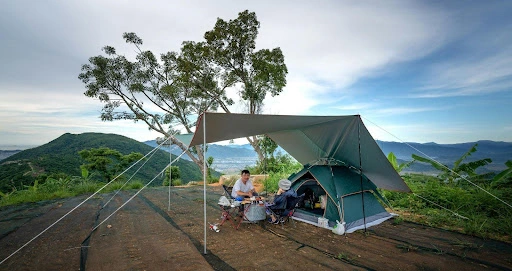
A freestanding tent, meaning supported by its own poles, lets you pitch quickly and adjust on the fly. The ideal shape is low and rounded, with a maximum height under 1.2 meters to minimize wind catch. Dome tents achieve this with crossing pole sleeves that form load-sharing triangles; tunnel designs work just as well when the narrow end faces into the breeze and the door stays on the opposite side of the wind.
It’s important that the shelter fabric remains drum-tight. Loose panels flap, potentially damaging the tent and also keeping you awake with loud noise. Add guylines to every tie-out loop-typically six to eight on a four-season model-and tension them evenly so no panel bellies outward. Stakes driven at a 45-degree angle away from the tent hold twice as well as vertical ones.
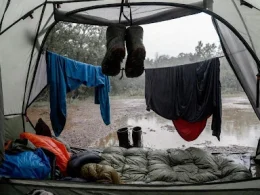
Vestibules prove their worth in gusty weather. They keep packs, boots, and cook kits outside the sleeping area, cutting down on door openings that admit blasts of cold air. If the tent has a snow skirt, bury the lower edge in duff, sand, or snow to seal the gap where wind loves to knife underneath.
In loose soil, double-stake each corner: drive one stake, clip the guyline, then hammer a second stake 20 cm away and loop the line around both. The pair resists uplift far better than a single point.
Tarps and Flat Shelters
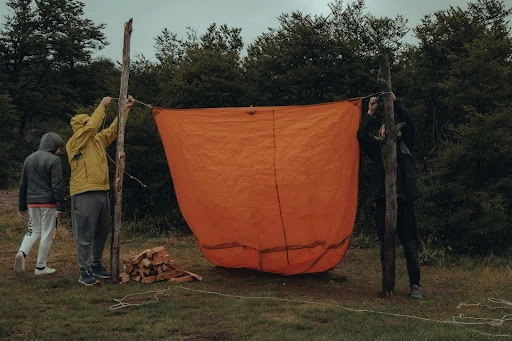
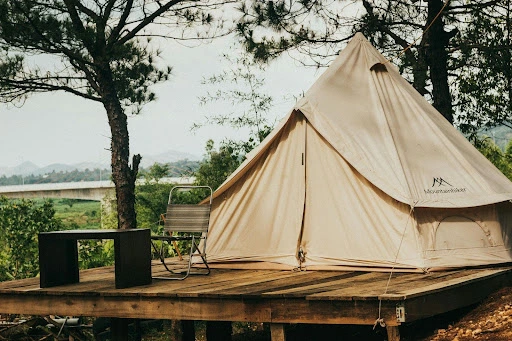
Tarps trade walls for weight and flexibility. An A-frame ridgeline strung between two trees or trekking poles creates a steep roof that sheds wind smoothly. Keep the lower edge 30 to 50 cm above ground-high enough to crawl under, low enough to avoid acting like a sail. Stake the four corners first, then add mid-panel tie-outs to stop the center from lifting.
A lean-to needs only one high anchor. Tie the ridgeline at chest height, walk the opposite edge downwind, and stake it flat. The sloping panel deflects air upward while the open side faces away from the breeze.
Solo travelers often choose the diamond or plow-point pitch. Drive a single trekking pole into the center, drape the tarp over it, and stake the four corners into a tight diamond. The resulting pyramid slices wind cleanly. Every grommet and perimeter tie-out must be reinforced.
Pair any tarp with a lightweight groundsheet clipped at the corners to block ground splash and create a sealed floor. If the tarp is large enough, the entire rig can sleep two comfortably and still be lightweight.
Ultralight and Emergency Shelters
When every gram matters, a bivy sack is the bare minimum. Modern versions use breathable waterproof fabric with a short hoop over the face to keep the material off your nose. Setup is instant: unroll, slide in, cinch the hood. The low profile lets wind slide past, though ventilation is limited-best for dry cold or as an emergency boost inside a larger shelter.
Single-wall micro-tents add one flexible pole and a sewn-in floor. The pole arcs from head to foot, forming a narrow space just wider than a sleeping pad. Stake the foot end, insert the pole, stake the head, and you’re sheltered in under two minutes. The sloping walls shed wind better than a flat bivy and allow you to sit up to cook or dress.
In a treeless country, improvise. Dig a trench 30 cm deep and twice your shoulder width, piling the spoil into a curved windbreak on the upwind side. Drape a tarp over trekking poles laid across the trench or simply weigh the edges with rocks. In snow, cut dense blocks to build a knee-high parapet. These are one-night solutions-prolonged storms demand something sturdier.
Final Thoughts
Wind protection is a simple equation: camp in the lee of the landscape, choose a shelter whose shape parts the air rather than catching it, and lock every corner down with deliberate tension. Practice the pitch on a breezy afternoon in the local park-muscle memory beats theory when stakes are blowing sideways. Master these steps and the wind becomes accompanying background noise, leaving your mind at ease.