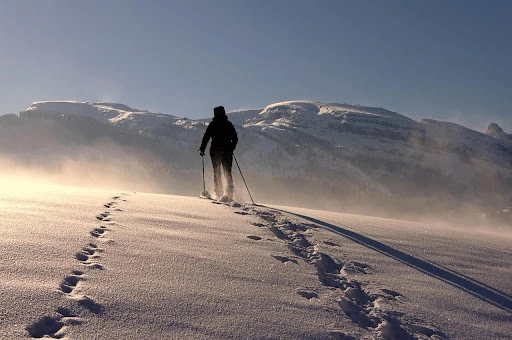
You’re standing at the trailhead looking down a winter path that’s been well-trodden. The snow looks firm, white and inviting. You reach into your car or pack and hesitate: should you go with microspikes or snowshoes? This is one of the most important, and most misunderstood, gear choices winter hikers face every time they head out on a winter trail.
Packed trails can be a real challenge. They’re not deep powder, but they’re not bare ground either. Conditions can shift from frozen hardpack to slick ice to churned-up snow in the space of a mile. The wrong traction can slow you down, suck the energy out of your legs, or make for some hairy moments on climbs and descents.
This guide is meant to help you make the right call when you’re faced with real-world packed winter trails. We’re going to break down how microspikes and snowshoes actually work, how they perform on packed trails, and what factors you should be thinking about when deciding which one to carry – so you’re not lugging around unnecessary gear.
Table of Contents
How Microspikes and Snowshoes Work
Microspikes and snowshoes are generally lumped together as “winter traction” but they actually solve different problems.
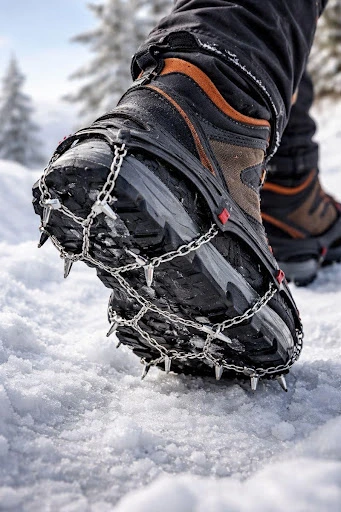
Microspikes are lightweight chains that slip over trail runners or hiking boots. They use a bunch of short steel points connected by chains to bite into ice and hard-packed snow. The stretch harness makes them quick to put on and take off, which is perfect for variable conditions. Microspikes don’t add any flotation – all they care about is keeping you on your feet.
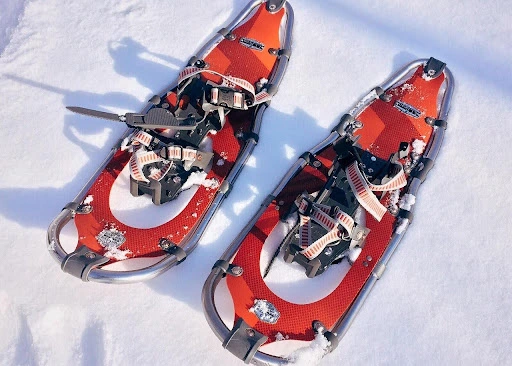
Snowshoes, on the other hand, are all about flotation. The wide deck spreads your weight out so you don’t sink into deep snow. Modern snowshoes also usually have crampon teeth under the foot for grip, and some even have heel lifts to reduce calf strain on climbs. They’re heavier and bulkier than microspikes, and designed to be worn continuously.
Put simply, microspikes are all about improving your grip on firm surfaces, and snowshoes are there to keep you on top of the snow when it’s not firm.
Performance on Packed Winter Trails
On packed winter trails, grip is usually more important than being able to float through deep snow – and that’s where microspikes come into their own.
On hard-packed snow and ice, microspikes are what you want. They give you a consistent grip. The steel points can get into frozen surfaces, making them especially good for icy traverses and downhill sections. For groomed trails and well-traveled routes, they often feel like the perfect match.
Snowshoes can grip packed snow, but it’s not their biggest strength. Their crampons are designed to work with a bit of flotation, and on very firm or icy trails they can feel like a bit of a clunky, imprecise option. Their wider stance can also get in the way of a natural stride.
Efficiency is another key factor. Microspikes let you walk normally, which reduces fatigue over distance. Snowshoes, on the other hand, require a wider step and more foot lift, which increases energy expenditure on packed terrain where you don’t need extra flotation.
Inclines are another area where the difference really shows. Microspikes are great on moderate slopes and switchbacks where firm footing is key. Snowshoes can be helpful on steeper climbs if the snow gets soft, but on hardpack they often feel like overkill.
Pros, Cons and Best-Use Scenarios
Microspikes are a great choice when trails are hard-packed, icy, or well-traveled. They’re light, fast, and effective, making them perfect for winter hiking, trail running and high-mileage days. Their biggest limitation is depth – once the snow gets soft enough that you start postholing, microspikes aren’t enough.
Snowshoes, on the other hand, are a good idea when packed trails start to break down – like after a fresh snowfall, on a warm afternoon, or on less-traveled routes where the snow isn’t solid. Snowshoes also make sense if you expect to be doing some off-trail travel or wading through drifts, even if the main trail starts out firm.
The problem with snowshoes on packed trails is that they’re just not as efficient. They’re heavier, slower and unnecessary when you don’t actually need extra flotation. Lots of hikers carry snowshoes “just in case” and never need them – and that’s a shame, because they add weight and fatigue.
A rough rule of thumb: if you’re not sinking more than an inch or two into the trail, you’re probably better off with microspikes.
Practical Buying Considerations and Alternatives
Packability is a big consideration, especially if you expect conditions to change. Microspikes compress easily and fit inside most packs, while snowshoes are bulkier and usually need to be strapped on the outside – which can be a bit of a pain in brushy terrain.
Footwear compatibility is also worth thinking about. Microspikes work well with trail runners, hiking boots and winter boots, while snowshoes require compatible bindings and may not feel stable with lightweight footwear.Price also has a role to play – microspikes are often a fair bit cheaper and need less fiddling around with in terms of maintenance. Snowshoes cost more and the various parts can wear out over time, like bindings and decking.
There are other options out there too. Crampons will give you much better grip on steep icy surfaces, but for most packed trails that’s a sledgehammer – they’re way more than you need. Then there are the more lightweight traction devices like Yaktrax – they do okay on mild stuff but really struggle with proper ice. For most packed winter trails, though, microspikes or snowshoes are probably the way to go.
Final Thoughts
It’s all about the surface conditions when deciding between microspikes and snowshoes – it’s not just about how deep the snow is. If the trail is firm, icy, groomed or well-trodden, microspikes are the more sensible choice. But if the trail starts to soften up, drifts, or gets all broken up as the day wears on, snowshoes are probably a safer bet.
Take a look at the recent trail reports, think about how the temperature is likely to change and what the conditions might be like when you’re actually out there. And if you’re still unsure – just match the gear to the surface you expect to be walking on most of the time.