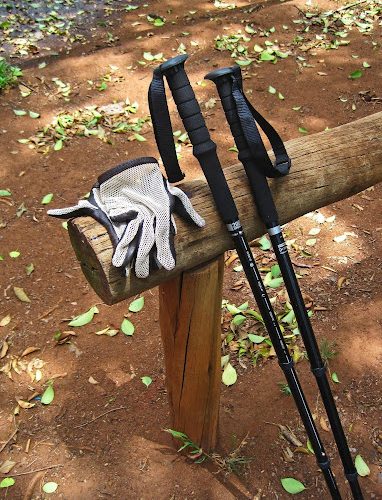
There’s a moment on every trail where you’ll pass someone confidently striding along with two trekking poles, arms swinging like they’re cross-country skiing down the path. And then, ten minutes later, you’ll pass someone else who’s stuffed their poles into their pack straps, tips pointing skyward, completely forgotten. Both of them paid good money for those poles but only one of them is getting their money’s worth today.
The easy answer to whether you need trekking poles isn’t a straight yes or no. It depends on what you’re hiking, how you’re hiking it, and what shape your knees are in.
Table of Contents
What Poles Actually Do
The case for trekking poles is strongest on two kinds of terrain: long descents and off-trail scrambling. On the way down, they are an early warning system for your knees. Every time your foot lands on a downhill step, your knee absorbs a force roughly three to four times your body weight. Trekking poles intercept some of that load before it ever reaches the joint. Over a 2,000-foot descent, that adds up fast, especially if you’ve already got ten miles in your legs.
The physics are simple enough. Planting a pole slightly ahead of you on a downhill step transfers a portion of your weight into your arms and shoulders. Those muscles are fresh. Your quads are not.
On uneven or loose terrain poles do something different. They widen your base of support. Instead of balancing on two contact points, you’ve got four. That’s not a small thing when you’re hopping across wet rocks with a 30-pound pack shifting your center of gravity in directions you didn’t necessarily ask for.
Trekking poles can also help on long, flat carries where fatigue is bound to happen. Engaging your upper body distributes the cardiovascular effort more evenly, which is why thru-hikers almost universally use them. When you’re covering 20 miles a day for weeks at a time, any way to spread the load matters.
When Poles Become Dead Weight
Contrary to what I wrote above, on a well-maintained, mostly flat trail, trekking poles are largely useless. They occupy your hands, snag on roots, click annoyingly on rock slabs, and require you to think about your arm placement when you’d rather just walk. If your trail doesn’t include a mountain route, the poles can probably stay in the car.
The same logic applies to short, low-stakes hikes. If you’re doing a 4-mile out-and-back with minimal elevation gain, the time it takes to adjust the length, strap in, and coordinate four limbs instead of two probably isn’t worth it. Some hikers bring poles on every single outing out of habit, which is fine, but don’t mistake habit for necessity.
There’s also a learning curve that people rarely mention. Poles used badly are worse than no poles at all. If you’re planting them behind your body, or white-knuckling the grips without using the wrist straps properly, you’re just adding drag. The technique takes a few miles to feel natural, and until it does, you might find yourself tripping over them on technical terrain rather than feeling more stable.
And if you’re a photographer, a birdwatcher, or someone who just likes to stop and use their hands, poles can feel like a nuisance. Folding and stowing them mid-hike interrupts your rhythm in ways that start to feel like more hassle than they’re worth. As a photographer myself I will never bring them with me as it is far too much to juggle.
The Knee Question
If your knees are already giving you trouble, you are probably going to need trekking poles.
Kneecap pain, old ACL injuries, general wear that comes with age, all of these make downhill hiking genuinely punishing without some form of load management. Poles are the cheapest, lightest intervention available. They won’t fix anything, but they’ll let you finish the hike without spending the next two days not being able to unbend your leg.
If your knees are fine then things are different. You can probably get away without poles on most moderate hikes. But “getting away without them” and “they wouldn’t help” aren’t the same thing in my books.
What to Look For If You Do Buy Trekking Poles
Not all poles are created the same, and the difference between a good pair and a bad one is mostly felt on the third hour of a difficult trail.
Carbon poles are lighter but will eventually crack under side-load stress. They’re better for fast-and-light trips where you’re using them for rhythm rather than serious bracing. Aluminum poles cost less and take abuse better. For most beginner-to-intermediate hikers, aluminum is probably the smarter call.
Twist-lock mechanisms are simple but can slip at inconvenient moments. Lever-lock (flick-lock) systems are more reliable and easier to adjust mid-hike with gloves on. If you’re hiking in cold weather, that matters.
Grip material comes down to personal preference, but cork grips absorb sweat and mold slightly to your hand over time. Foam is softer but wears faster. Rubber grips are fine for cold conditions but get slippery when your hands are warm. In my opinion, cork is probably your best bet for longevity.
Final Thoughts
Poles earn their place in your kit when the terrain is demanding, the mileage is high, or your knees have already filed a formal complaint with your body. For everything else I would say they’re optional. The worst reason to carry them is because everyone else does. The best reason is because you’ve done a long descent without them and spent the following morning walking like a 90-year-old. Try both. Your body will tell you what it thinks.