Bears get all the attention in camping safety content, and coyotes and wolves barely get a mention. That always struck me as a bit backwards, cause depending on where you’re camping in Ontario, you’re honestly more likely to hear a coyote yipping near your site at night than you are to see a bear at all. So let’s actually talk about it.
Most encounters with either animal end the same way: they see you, they leave. Coyotes and wolves are naturally wary of humans and go out of their way to avoid direct contact. But knowing how to tell them apart and knowing how to respond if one does not immediately bolt is worth having in your back pocket before you need it.
Table of Contents
Telling Them Apart
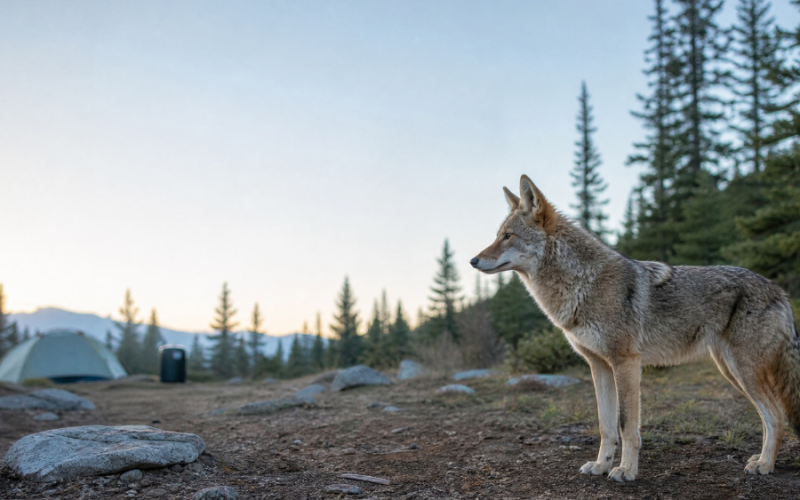
Coyotes are the smaller of the two, usually 20 to 50 pounds, with a narrow pointed snout and large ears relative to their head size. Their tail hangs low, below the line of their back, and their gait has a light, almost bouncy quality to it. You’ll also sometimes hear coywolves mentioned, which are coyote-wolf hybrids common in parts of eastern Canada, and they behave more like coyotes than true wolves.
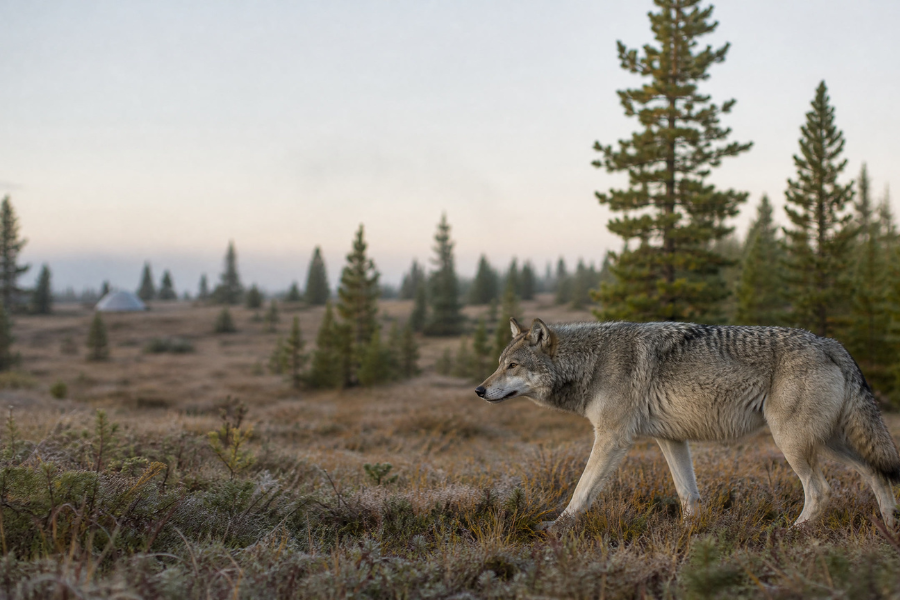
Wolves are a different animal entirely, literally. They run 70 to 150 pounds, with a broader head, shorter rounded ears, and a tail carried straight out rather than drooping. Their stride is heavier and covers more ground with less effort. If what you’re looking at seems genuinely large, moves with real purpose, and doesn’t look like a big dog, you’re probably looking at a wolf.
Honestly though, in the moment, you might not stop to do a detailed anatomy check. And that’s fine, cause the response for both is basically the same.
Curious vs. Actually a Problem
Most of the time what looks like an “approach” is just curiosity. A coyote passing through the edge of your site at dusk, checking things out from a distance, is not the same as one walking directly toward you. Distance and body language tell you a lot. An animal that keeps its distance, watches you, and moves off when you make noise is behaving completely normally.
What’s worth paying attention to is an animal that keeps closing the distance despite you making noise, one that shows no fear response at all, or one that’s acting strangely, staggering, drooling, unprovoked aggression. That combination can point to illness, including rabies, and that’s a different situation entirely. If you see that, do not try to handle it yourself. Back away and report it to a campground host or the nearest ranger station as soon as you can.
What to Actually Do
If a coyote or wolf is approaching and not backing off on its own, the first rule is don’t run. I know that’s the instinct, but running triggers a chase response in both animals. Stand your ground instead.
Make yourself look bigger. Raise your arms, stand tall, and use a loud, firm voice. Clapping, yelling, banging something together, all of that works. This is often called hazing, and it’s the standard response wildlife agencies recommend for both species. Throwing rocks or sticks in the animal’s direction, not at it directly, can also help push it along.
If it doesn’t retreat right away, keep making noise and slowly move toward your vehicle or a secure structure if one’s nearby, like a campground washroom. Don’t turn your back and don’t sprint. A slow, deliberate retreat while continuing to look big and loud is the move.
Maintain eye contact through this whole thing. Looking away or turning your back can read as you backing down, which is the opposite of what you want it to think.
Where the Real Risk Actually Is
Here’s something that doesn’t get said enough: for most campers, the real risk isn’t a direct attack. It’s your dog. Coyotes in particular view small dogs, especially anything under about 25 pounds, as potential prey rather than a threat to avoid. This has been documented in urban and suburban settings plenty of times, backyards, leashes, even through gaps in fencing.
Keep dogs leashed and close, especially at dawn and dusk when both coyotes and wolves are most active. Don’t leave pets unattended outside your tent, even for a few minutes. And be extra cautious during denning season, roughly March through May, when both animals are more protective of a specific area and more likely to respond defensively if a dog wanders too close to a den.
Keeping It From Becoming a Problem in the First Place
Most of this comes down to prevention, same as bears. Store food properly, keep your site clean, and never feed a coyote or wolf, even accidentally by leaving scraps around. An animal that gets a food reward near a campsite loses its natural wariness fast, and that’s how a shy, avoidant species turns into a bold one that keeps coming back. That’s genuinely bad for you and bad for the animal, since habituated wildlife often doesn’t end well for them either.
Final Thoughts
Coyotes and wolves are not the threat most people build them up to be in their heads. Actual attacks on humans are rare, and the vast majority of encounters end with the animal moving off on its own. But knowing how to respond, standing your ground, making noise, protecting small pets, and recognizing when something’s genuinely off with an animal’s behavior, means you’re prepared instead of just hoping nothing happens. That’s really all camping safety ever is.