Most people pack up their gear when summer ends or wait until the heat is guaranteed before they head out. That’s understandable. But it also means they’re missing the best part of the camping year.
Shoulder season, the weeks that bookend summer on either side, doesn’t get nearly the attention it deserves. Spring and fall camping carry a reputation for unpredictability, for being the consolation prize you settle for when the calendar doesn’t cooperate. That reputation is wrong. Camping in the shoulder season isn’t a compromise. For a lot of people who spend real time outside, it’s the preference.
Here’s why.
Table of Contents
The Silence Is Real
There’s a particular kind of quiet that only exists when the crowds have gone home. You can feel it the moment you pull into a campsite in late September or early May. The loops that were packed solid in July are now half-empty, sometimes completely empty. The fire rings don’t have someone else’s garbage in them. You can hear the creek.
This isn’t just about comfort, though that’s part of it. It changes how you experience the place. When you’re not surrounded by other people’s noise, you start to notice things. Bird sounds carry further. You spot wildlife that would have been scared off by the summer foot traffic. A trail that felt like a highway in August becomes something that actually belongs to you for a few hours.
Campsite selection opens up too. The spots everyone fights over in peak season, the ones right on the water or tucked away from the road, are suddenly available. You can take your time, set up the way you actually want to, and not feel like you’re camping in a parking lot.
The Weather Is Often Better Than You Think
This is the part that surprises people. Shoulder season weather, particularly in spring and fall, can be some of the most comfortable camping weather of the year.
Think about what peak summer actually delivers in a lot of North America: hot nights, humidity that makes sleeping difficult, afternoon thunderstorms that roll in without much warning, insects that make sitting outside without a fire almost unbearable. July and August camping has its appeal, but comfort isn’t always at the top of the list.
Early fall changes all of that. Daytime temperatures are typically warm enough to hike in a t-shirt, but cooler air moves in at night and actually makes sleeping in a tent feel good rather than suffocating. There’s a crispness to the air that just doesn’t exist in the thick of summer. The bugs have largely died off. The humidity drops. Evenings around the fire stop being something you do to ward off mosquitoes and start being something you do because you genuinely want to sit there.
Spring has its own version of this. After a winter of being cooped up, even a cool day outdoors feels like a gift. The landscape is doing something interesting, green pushing up through everything, water running high and fast. The light is different in a way that’s hard to describe until you’ve seen it.
Neither spring nor fall is a guaranteed weather window. You’re going to have to layer more thoughtfully, keep a rain layer accessible, and pay attention to the forecast in a way you might not bother with in midsummer. But that’s a fair trade. Most shoulder season campers will tell you they’d take a cool night and a quiet campsite over a hot, crowded weekend any day.
Your Gear Actually Gets Used
There’s another angle to shoulder season camping that doesn’t get talked about enough: it makes you a better, more prepared camper.
Summer camping forgives a lot of mistakes. Forget a layer? You probably won’t need it. Bring a sleeping bag that’s rated too warm? You’ll survive. The conditions are rarely going to push you in a direction that requires real preparation.
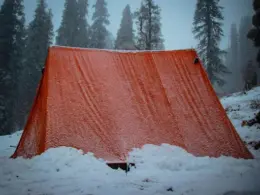
Shoulder season asks more of you. Not in a dangerous way, but in a way that engages your thinking. You start paying attention to your layering system, understanding what base layers actually do versus insulating layers versus wind protection. You learn to set up camp with an eye toward the wind direction rather than just the view. You figure out that a sleeping bag rated to 32°F is a very different experience at 37°F than it is at 60°F, and you plan accordingly.
That knowledge compounds. Campers who spend time outside in the shoulder season tend to show up to every trip better prepared, with a clearer understanding of how their gear actually performs.
The Trade-Off Is Worth It
None of this is to say shoulder season camping has no downsides. Days are shorter in the fall. Some facilities at campgrounds, like shower blocks or convenience stores, may be closed. Certain trails get muddy in the spring and stay that way for weeks. You might get rained on.
The difference is that when the sun comes out after a shoulder season of rain, the air smells like something. The light hits the wet leaves and the whole place looks like it was set up for you specifically. There’s a quality to those moments that peak-season camping, with all its crowds and heat and noise, tends to drown out.
Camping is, at its core, about paying attention to where you are. Shoulder season makes that easier. The distractions are fewer, the conditions sharper, and the experience more your own.