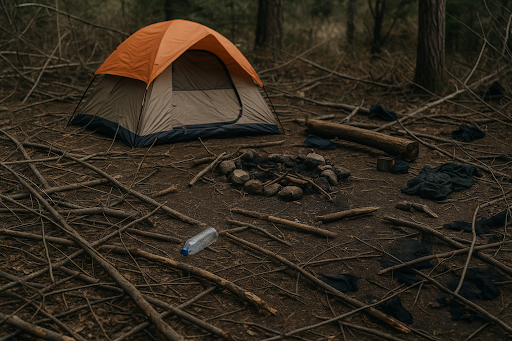
There’s a moment most campers know well. You’ve driven a few hours, you’re tired, the light is fading, and the first flat-looking patch of ground you find feels good enough. So you pitch there.
And then sometime around 2 a.m., you find out it wasn’t.
Maybe there’s a root that wasn’t obvious under the leaves. Maybe the ground slopes just enough that you’ve spent the night slowly sliding into your tent wall. Maybe it rained for twenty minutes and your tent is now sitting in a shallow puddle that wasn’t there when you set up.
Reading the ground before you pitch is one of those skills that experienced campers do automatically – almost without thinking. But because it’s never really taught, a lot of newer campers skip it entirely and just hope for the best. This is how you stop doing that.
Table of Contents
Flat Ground Is Rarer Than It Looks
The first thing to do when you find a potential site is to stand in the middle of it and look around. Does the ground tilt in any direction? Even a few degrees matters. Then crouch down and eyeball it from lower. Small slopes that are invisible from standing height become obvious when you get your eyes closer to the ground.
If you’re camping somewhere with a slight slope and have no better option, always position yourself so your head is uphill. Feet-down is uncomfortable. Head-down is miserable and actually affects your sleep quality. And never pitch so your body runs side-to-side across a slope – you’ll spend the whole night fighting gravity to stay in the middle of your sleeping pad.
When you can, look for natural flat spots: the inside curve of a hillside, the top of a small rise, or areas where the soil has clearly settled and compacted over time.
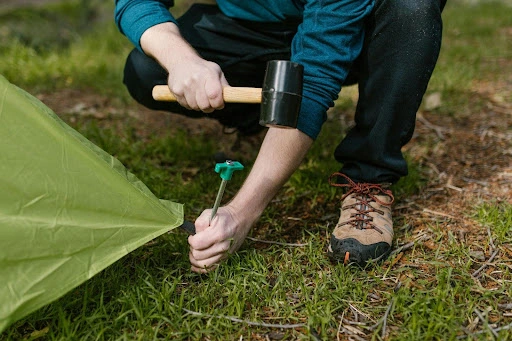
Figure Out Where the Rain Is Going to Go
This one matters most when rain is in the forecast, but it’s worth doing every single time regardless.
Water runs downhill and pools in low spots. Your job is to figure out where the low spots are before you camp in one.
Look at the vegetation around you. Lush, dense, dark green plants – especially mosses – tend to grow where the ground stays wet longer. Sparse, patchy grass or exposed dirt can indicate ground that drains well. If there are any small channels, depressions, or worn paths through the soil, those are drainage lines. Don’t pitch across them or at the bottom of them.
Take a look uphill from your potential site too. If there’s a slope above you, ask yourself: where does water go when it runs off that slope? Does it funnel anywhere? If your tent is at the end of that funnel, you’re going to wake up in a river.
The goal isn’t to find perfectly dry ground – it’s to find ground that sheds water away from you rather than toward you.
What the Soil Is Actually Telling You
Soil type tells you a lot about what your night is going to feel like, and it also affects how well your stakes are going to hold.
Press your heel into the ground and twist it slightly. If the surface compresses easily and stays compressed, the soil is soft and potentially waterlogged – stakes will hold but the ground may feel spongy. If it barely gives, it’s compacted or rocky underneath. Your stakes aren’t going in without a fight, and you’ll feel every stone through your pad.
Sandy soil drains fast but stakes pull out easily, especially if there’s wind. Clay-heavy soil holds stakes well but holds water too – it can feel fine when dry and soggy within minutes of rain.
None of these are dealbreakers on their own. They’re just information. Knowing what you’re working with helps you decide whether to use longer stakes, stake out your guylines, or move on to a different spot.
The Stuff Hiding Just Below the Surface
Before you commit to a spot, do a slow sweep – literally walk the footprint of your tent before you pitch it.
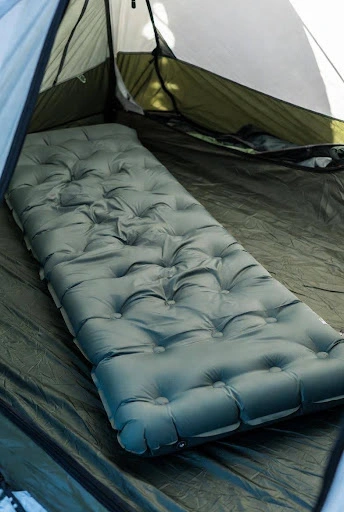
Look down first. Exposed roots are obvious, but partially buried ones aren’t. Scuff the surface with your foot in a few spots to see what’s just below the leaf litter or grass. A root you can’t see until you’re lying on it at midnight is one of the most reliably miserable camping experiences there is. Same goes for rocks – small ones you barely notice standing up become remarkably sharp and specific when you’re sleeping on top of them.
Then look up. Are there dead branches overhead? Any trees that look damaged, leaning, or hollowed out? In heavy wind, those become a real hazard. It’s also worth checking for beehives, wasp nests, or anything else that suggests the space above you is already occupied.
The Thirty-Second Habit That Changes Everything
You don’t need to spend twenty minutes analyzing every campsite. Once this becomes a habit, it takes about thirty seconds.
Find a potential spot. Crouch and check the slope. Scan the vegetation for signs of moisture and drainage lines. Look uphill for runoff paths. Scuff the surface to check for roots and soil feel. Look up for hazards.
If everything looks reasonable, you pitch. If something feels off, you move five meters and check again.
The campers who wake up dry and comfortable aren’t just lucky with the weather. They spent thirty seconds making a good decision before the sun went down.
Head over to our camping section to gear up for your next adventure.